Controlled char removal addresses the specific mechanical threshold where fire heat degrades the tensile strength of load-bearing wood framing. When timber exposure exceeds 570 degrees Fahrenheit, pyrolysis converts…
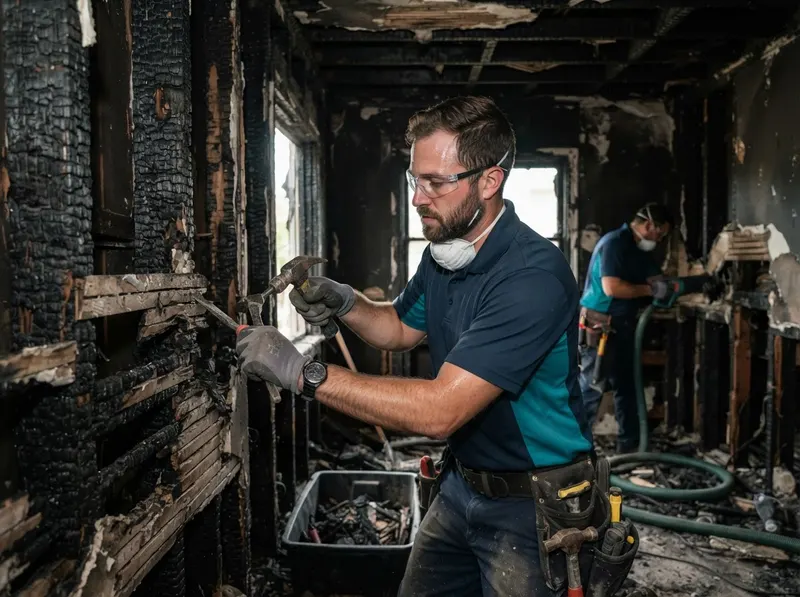
Controlled char removal addresses the specific mechanical threshold where fire heat degrades the tensile strength of load-bearing wood framing. When timber exposure exceeds 570 degrees Fahrenheit, pyrolysis converts virgin wood into brittle, off-gassing carbon. Structural demolition removes framing members that have lost more than 20 percent of their cross-sectional dimension or show structural deflections exceeding engineering tolerances, whereas controlled char removal utilizes dry ice blasting or abrasive soda blasting to abrade charred outer surfaces down to healthy structural timber. In residential framing across hillside communities such as Silver Lake, Los Feliz, and Pacific Palisades, selective removal prevents unnecessary full-scale teardowns while meeting strict building code requirements enforced by the Los Angeles Department of Building and Safety (LADBS). Dry ice blasting projects frozen carbon dioxide pellets at 300 pounds per square inch, lifting surface char without introducing moisture to framing already stressed by fire hoses.
The operational sequence moves systematically from temporary stabilization to definitive decontamination. Technicians install heavy-duty shoring jacks and timber cribbing to support weakened ceiling joists and floor spans in properties ranging from multi-story hillside houses in Brentwood and Studio City to flat-lot residences in Sherman Oaks and Cheviot Hills. Crews then strip saturated ceiling gypsum, wet blown-in cellulose insulation, and soot-glazed wallboard to uncover hidden structural cavities where thermal expansion has twisted structural fasteners. High-efficiency particulate air (HEPA) negative air machines operating at 2,000 cubic feet per minute capture airborne carbon particulates and carcinogenic polycyclic aromatic hydrocarbons during the entire deconstruction process, maintaining containment barriers between damaged sections and unaffected living spaces.
Material salvage decisions depend entirely on dimensional loss and structural integrity. A 2x6 stud charred deeper than one-quarter inch cannot sustain original engineered axial loads and requires structural sistering or total demolition, whereas heavy-timber beams commonly found in Highland Park craftsman homes or Echo Park mid-century structures can often be preserved via controlled shaving followed by structural sealant encapsulation. The critical trade-off lies between selective precision removal, which requires higher labor hours using hand tools and blast nozzles, and broad-scale mechanical tear-out, which accelerates clearance times but increases future framing reconstruction costs. All operational scopes align with standard insurance auditing metrics using verified Xactimate line items to prevent coverage disputes during claim adjustments.
Every job gets a firm, written price after a free on-site visit.
Tell us about your structural demolition & controlled char removal job in los angeles and we'll send a clear, written quote, usually the same day.
 Pro Fire Damage Restoration